Tuesday, November 2, 2010

Chapter 15: Process Writing


CHAPTER 15: PROCESS WRITING

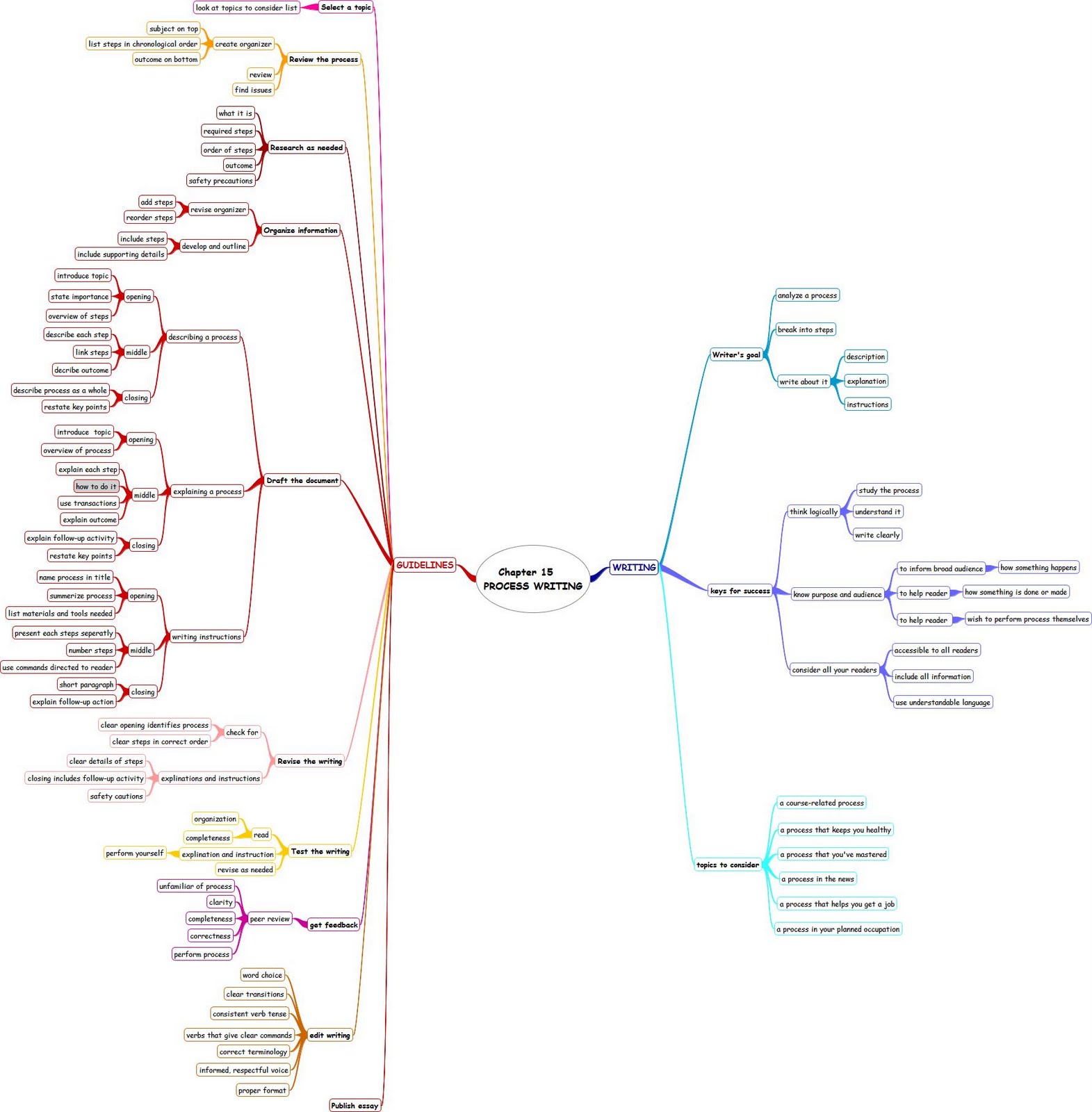
This chapter goes over writing an essay on a process. Your goal is to analyze a process and break it down into steps; then write about it as a description, explanation, or instructions on how to do the process.

Keys for success

· Think logically. Study the process and understand it and write clearly.

· Know your purpose and your audience. Inform a broad audience how something happens. Let the reader know how something is made or done. Show readers how to do a process themselves.

· Consider all your readers. Make your writing accessible to all readers, include all information, and use understandable language

Topics to consider

· A course-related process

· A process that keeps you healthy

· A process that you’ve mastered

· A process in the news

· A process that helps you get a job

· A process your planned occupation

Guidelines to writing about a process

1. Select a topic.

2. Review the process. Make an organized: subject on top, list the steps, and outcome on the bottom. Review and look for issues.

3. Research as needed. Look for information that shows what the process is, the required steps, order of steps, out come, and possible safety precautions.

4. Organize information. Revise organizer by adding steps and/ reordering the steps. Create and outline that includes steps and supporting details.

5. Draft the document

a. Describing a process

i. Opening: introduces the topic, states the importance, and an overview of the steps.

ii. Middle: describe each step links the steps, and describes out come.

iii. Closing: describe the process as a whole and restate key points.

b. Explaining a process

i. Opening: introduce topic and an overview of the process

ii. Middle: explain each step, how to do it, use transitions, and explain outcome.

iii. Closing: explain follow-up activity, and restate key points.

c. Writing instructions

i. Opening: name process in title; summarize process, and list materials and tools needed.

ii. Middle: number each step, present each step separately and use commands directed to reader.

iii. Closing: short paragraph describe follow-up action.

6. Revise the writing. Check for clear opening identifying process and clear steps in correct order. Check that explanations and instructions have clear details of each step, closing includes follow-up activity and safety precautions.

7. Test the writing. Read and check organization and completion on process. Perform the process yourself using the instructions and explanations. Revise as needed.

8. Get feedback. Get a peer reviewer who is unfamiliar with the process. Have them check for clarity, completeness, correctness and have them perform the process.

9. Edit writing by checking for word choice, clear transitions, consistent verb tense, verbs that give clear commands, correct terminology, informed and respectable voice, and proper format.

10. Publish essay.


Chapter 14: Classification


CHAPTER 14: CLASSIFICATION

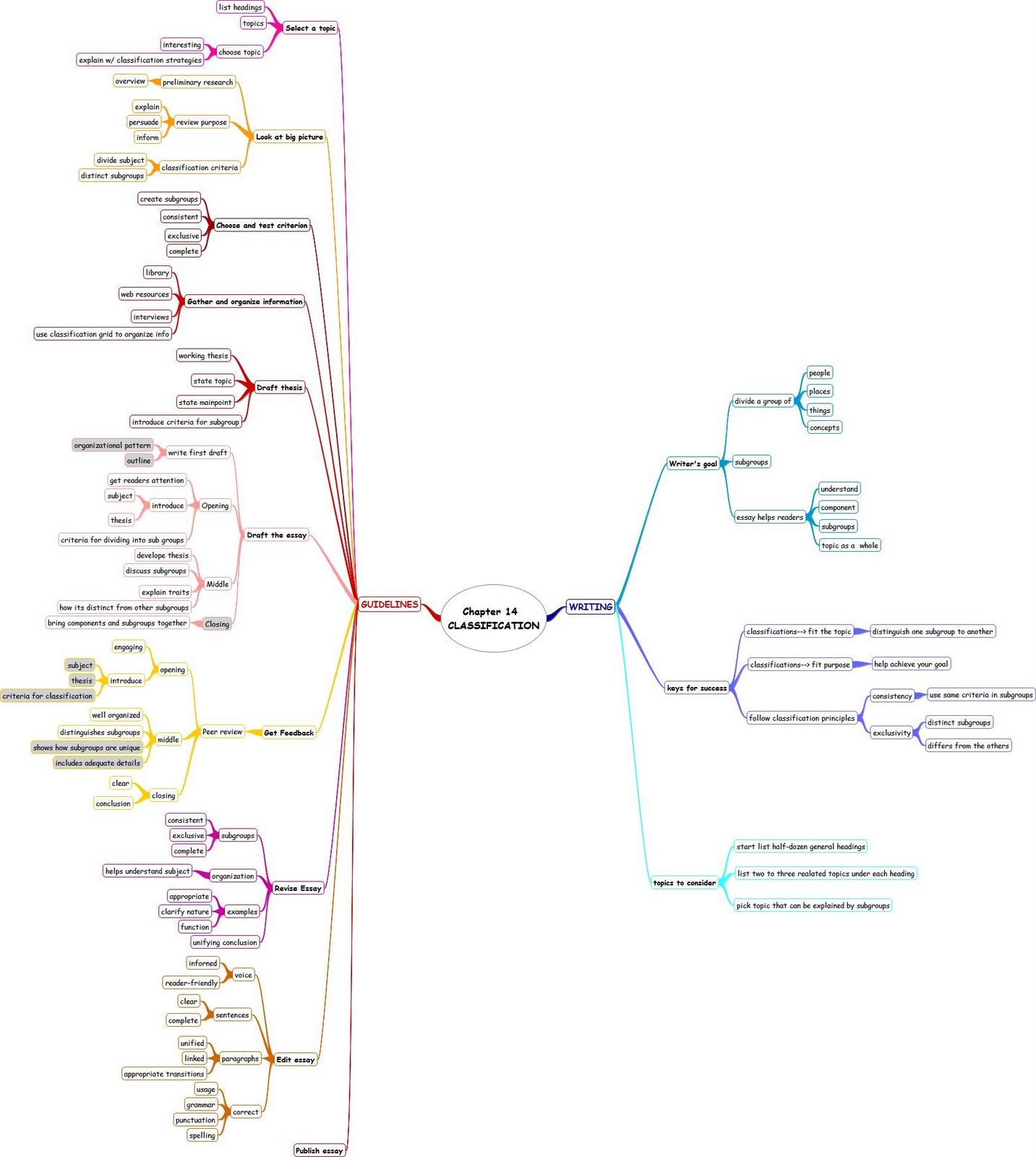
This chapter goes over writing a classification essay. Your goal is to divide a group of people, places, things, or concepts into subgroups, and write an essay that helps the reader understand each component, the subgroups and the topic as a whole.

Keys to success:

· Choose classifications that fit the topic. Distinguish one subgroup from another.

· Choose classifications that fit your purpose. Helps achieve your goal.

· Follow classification principles.

o Consistency: use some criteria in subgroups.

o Exclusivity: distinct subgroups that are different the others.

Topics to consider:

· Start with a list of a half-dozen general headings

· List two or three related topics under each heading

· Pick topic that can be explained by subgroups

Guidelines for writing a classification essay:

1. Select a topic. Choose a topic that is interesting to you and that you can explain using classification strategies.

2. Look at the big picture. Do preliminary research. Review your purpose; to inform, explain or persuade. Decide what classification criteria that will help you divide the subject into subgroups.

3. Choose and test your criteria. Create subgroups that are consistent, exclusive, and complete.

4. Gather and organize information. Look at the library, web resources, and interviews to get information. Use a classification grid to organize your information.

5. Draft a thesis. Make a working thesis that states the topic, main point, and introduce criteria for subgroup.

6. Draft the essay

a. Opening: gets readers attention. Introduces the subject and thesis, and the criteria for dividing into subgroups.

b. Middle: develop thesis, discuss subgroups, explain traits, and how they are distinct from one another.

c. Closing: bring components and subgroups together.

7. Get feedback. Peer reviewer checks that the opening is engaging and has the thesis and main idea, the middle is well organized includes distinct subgroups with details, and the closing is clear.

8. Revise the essay. Subgroups are consistent, exclusive and complete. The organization helps understand the subject. Examples are appropriate and functional. The conclusion is unifying.

9. Edit essay. Voice is informed and reader-friendly. Sentences are complete and clear. Paragraphs are unified and use appropriate transitions. Correct usage, grammar, punctuation and spelling

10. Publish essay


Chapter 13: Compare and Contrast


CHAPTER 13: COMPARISON AND CONTRAST

This chapter goes over writing a comparison and contrast essay. Your goal is write an essay that has two or more subjects side by side, shows how they are similar and different, and draws conclusions or makes some point.

Keys for success:

· Know your reader. What do they know? What should they know? Why should they care?

· Know your purpose. What do you want to do? Inform, explain, or persuade.

· Be logical. Helps understand the subject.

Topics to consider:

· Topics that are related in some way

· Objects, events, places, processes, people, ideas, beliefs.

Guidelines for writing a compare and contrast essay:

1. Select a topic. At least 2 subjects that are different but similar, interesting, perplexing, distinguishing, infuriating, charming, and informing.

2. Get the big picture. Brainstorm using 3 columns, traits of number 1, shared traits, traits of number 2.

3. Gather information. Review your list, highlight important topics, and research your subject.

4. Draft a working thesis. Review expanded list, eliminate unimportant information, state the core of what you learned.

5. Get organized. Decide how to organize, subject by subject, or trait by trait.

6. Draft the essay.

· Subject by subject:

Opening

Middle: traits of first subject parallel to second subject

Closing: similarities and differences, significant, and restate main point.

· Trait-by-trait

Opening

Middle: compare and contrast

Closing: summarize key relationships, note significance, and restate main point

7. Revise the essay. Check for balance in comparisons and contrasts, complete treatment of each subject, objective voice, clear sentences, and thoughtful conclusions.

8. Get feedback. Get peer reviewer to check for clear thesis, engaging introduction, middle compares, contrasts, and parallel traits, ideas offer insight, and conclusion restates main point.

9. Edit your essay. Transitions signal comparisons and link paragraphs, correct quotations and documentation, correct spelling, punctuations, usage, and grammar.

10. Publish your essay.