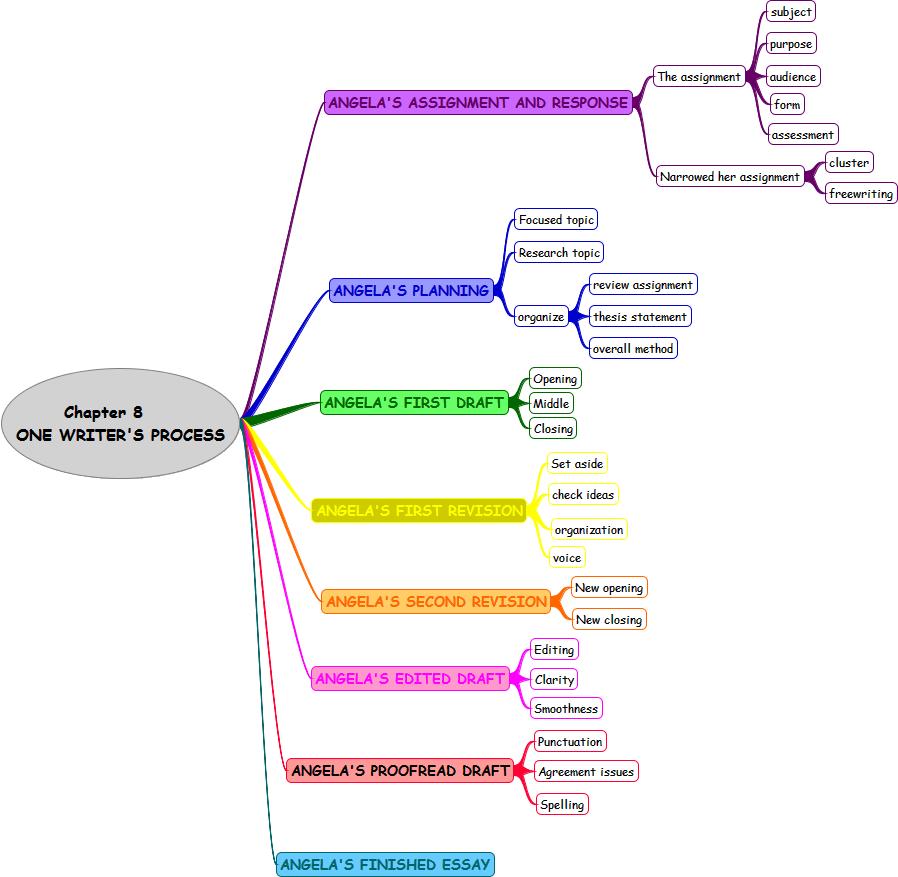
Angela begins by looking at her assignment and responding to it. She looks at the subject, purpose, audience, form, and assessment. Then she narrows her assignment by using a cluster and freewriting. Angela begins planning by focusing and researching her topic. She also begins to organize; reviewing her assignment, thesis, and overall method.
Angela writes her first draft making a opening, middle, and closing. She sets it aside before making her first revision. She checks ideas, organization and voice. In Angela’s second revision she writes a new opening and new closing. In her edited draft she edits, checks clarity and smoothness. She then proofreads her draft checking punctuation, agreement issues and spelling. Then she ends with her finished essay.
Chapter 7: Submitting writing and creating portfolios
When formatting your writing look at the clarity of your page design. Check that your format is clear and uncluttered, that you use designated documentation form and use easy-to-read font. Look at your spacing in the indents and margins, avoid widows and orphans. Check your graphic devices; bullets or number lists, and charts or other graphics.
When submitting writing and creating a portfolio you should consider your potential audience; share your writing, submit your work, post your writing and turn in your writing. Select appropriate submission methods either paper submission or electronic submission. Use a writing portfolio; working portfolio for various stages of development and showcase portfolio for finished work.
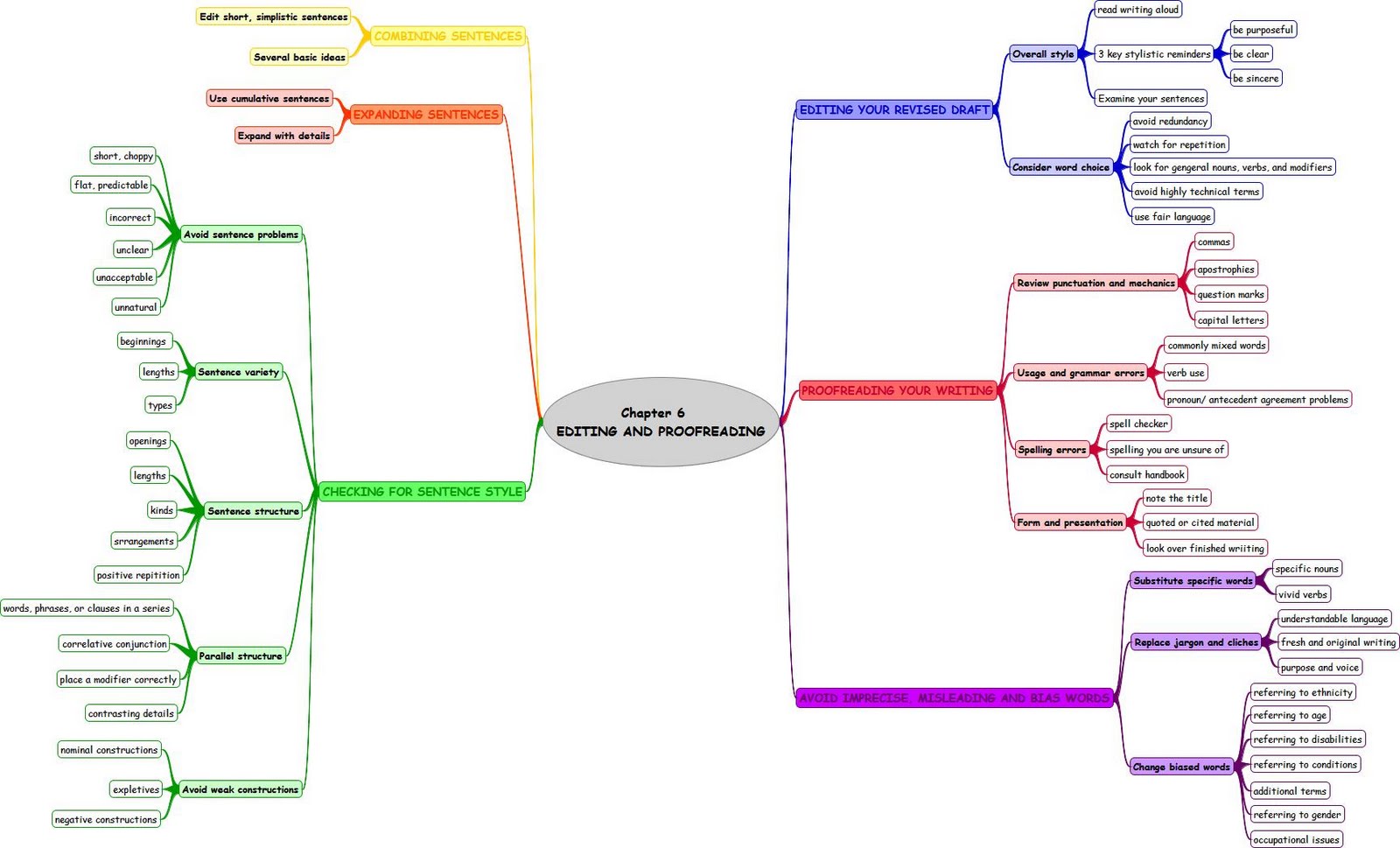
This chapter is about editing and proof reading your revised draft. Look at your overall style, read writing aloud, 3 key stylistic reminders: be purposeful, be clear, and be sincere, and examine your sentences. Consider your word choice; avoid redundancy, watch for repetition, look for general nouns, verbs, and modifiers, avoid highly technical terms, and use fair language.
Combine short, simplistic sentences with several basic ideas to make a longer more detailed sentence. Expand sentences by using cumulative sentences and expanding with details. Check for sentence style. Avoid sentence problems that are short, choppy, flat, predictable, incorrect, unclear, unacceptable, and unnatural. Check that sentence variety in the beginnings, lengths, and types. Check sentence structure; opening, lengths, kinds, arrangements, and positive repetition. Look at parallel structure; words, phrases, or cause in a series, use correlative conjunction, place a modifier correctly, and use contrasting details. Avoid weak constructions; nominal constructions, expletives, and negative constructions.
When proofreading your writing review punctuations; commas, apostrophes, question marks, and capital letters. Look at usage and grammar errors; commonly mixed words, verb use, and pronoun/ antecedent agreement problems. Look for spelling errors; use spell checker, check spelling you are unsure of, and consult handbook. Look at form and presentation; note the title, quoted or cited material, and look over finished writing.
Avoid imprecise, misleading and bias words. Substitute specific words; specific nouns and vivid verbs. Replace jargon and clichés; use understandable language, fresh and original writing and purpose and voice. Change biased words; words that referring to ethnicity, age, disabilities, conditions, gender, and occupational issuses.
This chapter goes over revising your first draft. When beginning to revise your essay look over whole-paper issues, remind yourself of your purpose and audience. Check your overall approach; check if the topic is worn out, the approach is stale, the voice is predictable or fake, the draft sounds boring, and the essay is formulaic.
Prepare yourself to revise. Think globally. Check your ideas; check thesis, focus and theme. Check your organization; look at the overall design, ideas run smoothly and logically. Check your tone of voice and attitude.
Revising for ideas and organization, examine your ideas by checking for complete thinking and clear thesis. Examine your organization; check your overall plan, opening ideas, flow of ideas, and cosign ideas.
When revising your voice and style, check your level of commitment as well as your intensity of writing. Develop an academic style; personal pronouns, technical terms and jargon, level of formality, and unnecessary qualifiers. Know when to use a passive voice. Weakness of a passive voice is it can be impersonal, wordy or sluggish. Strengths of a passive voice is it can be tactful, you can use it to stress something or something can be understood,, unknown or unimportant.
When addressing paragraph issues remember the basics; is the paragraph organized, is there supporting sentences and a closing sentence, and what is the specific function of the paragraph. Keep your purpose in mind, check function, flow and fit. Check for unity by looking at topic sentence, placement of topic sentence, supporting sentence, and consistent focus. Check for coherence; effective repetition and clear translation. Check for completeness, supporting details, and specific details.
Revise collaboratively; know your role, provide appropriate feedback; basic description, summary evaluation and thorough critique. Respond to plan by using OAQS method: Observe, appreciate, question, and suggest.